
guide -
The Best 4 Days in London Itinerary (Step-by-Step)
4 days in London itinerary planning, made simple: yes, four days is enough to see the big icons, get a real feel for a few neighborhoods, and still leave room for a show, a great meal, and one or two free museum stops. The best way to do it is to group sights by area—Westminster
4 days in London itinerary planning, made simple: yes, four days is enough to see the big icons, get a real feel for a few neighborhoods, and still leave room for a show, a great meal, and one or two free museum stops. The best way to do it is to group sights by area—Westminster and Central on Day 1, the South Bank and river on Day 2, a choose-your-own-pace neighborhood day on Day 3, and a flexible final day based on your travel style.
If you’re trying to build a trip that feels balanced instead of rushed, you’re in the right place. We checked the most practical routing, the places that are actually worth your limited time, and the entertainment add-ons that make London feel like more than a checklist of landmarks. This guide is written like a local friend helping you avoid the classic mistakes—too much zig-zagging, too many queues, and not enough time to enjoy the city’s atmosphere. You’ll find step-by-step day plans, neighborhood guidance, budget tips, show ideas, rainy-day swaps, and scenario-based recommendations for couples, families, friends, solo travelers, and work trips. We also added current-season planning advice for 2025-2026, plus official sources and Gidly-friendly discovery tips so you can keep your plans current.
Quick Answer: The Best 4 Days in London Itinerary at a Glance
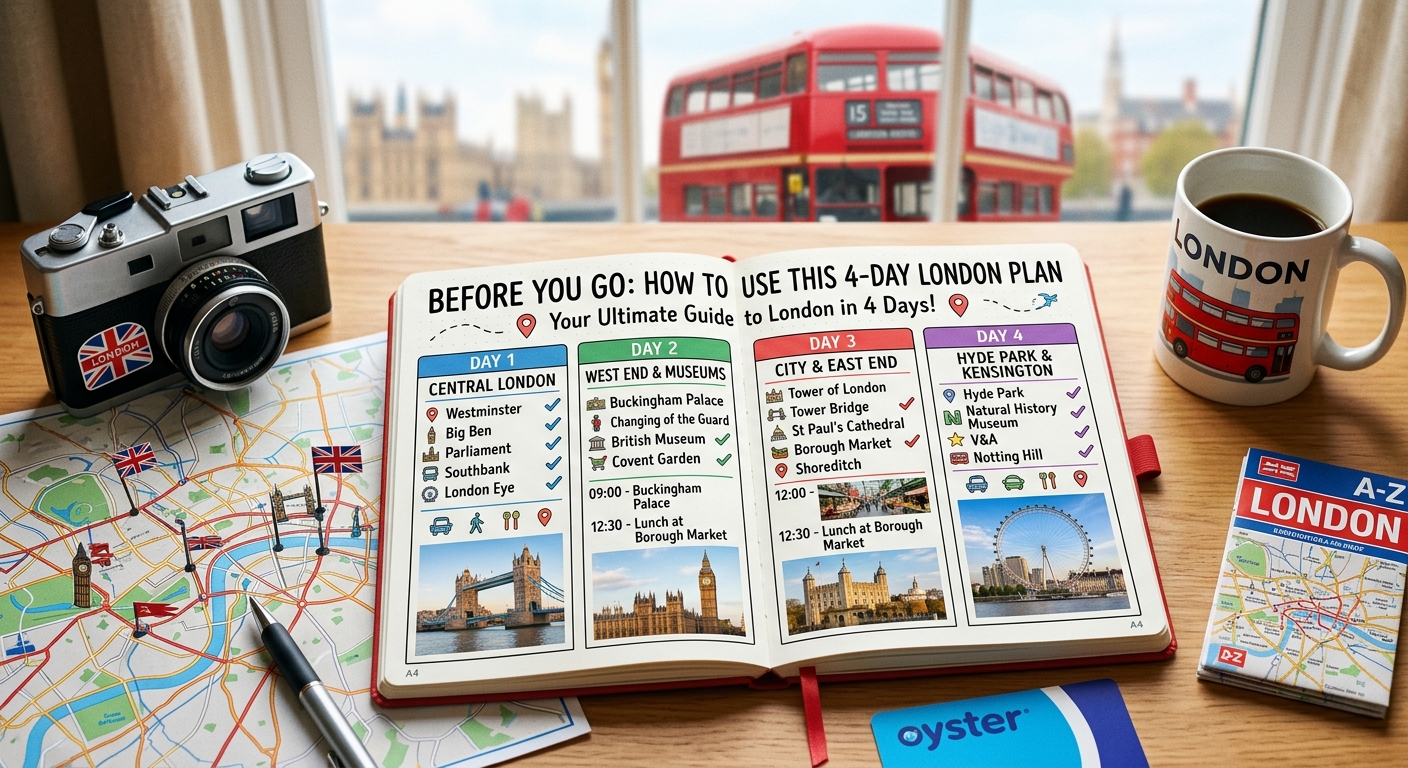
Here’s the short version: the best 4 days in London itinerary covers Westminster and Buckingham Palace on day one, the South Bank and Thames on day two, a flexible neighborhood or museum day on day three, and a fully customizable final day for extra icons, a West End show, or a slower local experience. That structure works because London is huge, but its best experiences become much easier when you cluster them by area instead of bouncing across town.
For most first-time visitors, this plan gives you the classic landmarks, a museum or two, a scenic river walk, a market lunch, and at least one evening of live entertainment. If you’re traveling as a couple, with kids, with friends, or solo, you can swap in the neighborhood that matches your vibe without breaking the overall flow. The result is a trip that feels full, not frantic, and it leaves you enough energy to enjoy the city after dark.
Who this itinerary is best for
This itinerary is ideal for first-timers who want the big London highlights without feeling like they’re spending the whole trip underground or in transit. It also works well for couples who want one romantic evening, friends who want a mix of sightseeing and nightlife, families who need a practical pace, and solo travelers who want flexibility and safety without sacrificing fun. We also like it for repeat visitors because the “choose your own adventure” structure lets you trade one area for something more local, like Greenwich, Hampstead, or Shoreditch.
If you’re the type of traveler who wants a little bit of everything—history, food, a scenic walk, a museum, and a show—this is your sweet spot. It’s also a strong fit for people visiting in 2025-2026, when the city’s event scene is especially experience-driven. More visitors are booking timed attractions, planning dinners around shows, and using neighborhood discovery to fill the evenings instead of overcommitting to giant list-style itineraries.
What you’ll see in 4 days
In four days, you can realistically check off Big Ben, Westminster Abbey, Buckingham Palace, Trafalgar Square, the National Gallery, the South Bank, the London Eye, Borough Market, St Paul’s Cathedral views, Tower Bridge, and at least one major museum such as the British Museum, the Natural History Museum, the Victoria and Albert Museum, or Tate Modern. That’s already a very strong London trip, especially if you add one West End night and one neighborhood that feels less tourist-heavy.
You should also plan for one river-focused experience because the Thames gives London its shape. That can be a bridge-to-bridge walk, a river cruise, or a quick hop on Uber Boat by Thames Clippers. And if you want the city to feel alive after sunset, build in one evening of theater, comedy, live music, or a good dinner in Soho, Covent Garden, or Shoreditch.
What this plan prioritizes
This itinerary prioritizes smart pacing, clustered neighborhoods, and a mix of free and paid attractions so you don’t spend your whole trip overpaying or overwalking. We’re not trying to cram every major museum into one visit; we’re trying to give you the best possible version of London in a limited amount of time. That means choosing the sights that are unmistakably worth it, then leaving breathing room for coffee, lunch, and the occasional detour.
It also prioritizes practical choices like transit ease, queue management, and flexibility for weather. London is one of the easiest cities to enjoy if you work with its geography rather than fight it. When you keep your days organized by area, you save time, reduce stress, and create room for the parts travelers remember most: a pub lunch, a sunset over the river, a spontaneous street performance, or a brilliant West End curtain call.
| Day | Main Area | Highlights | Best For |
|---|---|---|---|
| Day 1 | Westminster / Central | Big Ben, Westminster Abbey, Buckingham Palace, Trafalgar Square | First-time icons |
| Day 2 | South Bank / Bankside | London Eye, Tate Modern, Borough Market, Thames views | Scenery and culture |
| Day 3 | Choose your neighborhood | Museums, Shoreditch, Notting Hill, Greenwich, Hampstead | Personal style |
| Day 4 | Flexible finale | Tower of London, show night, family fun, slow local day | Custom plans |
Before You Go: How to Use This 4-Day London Plan
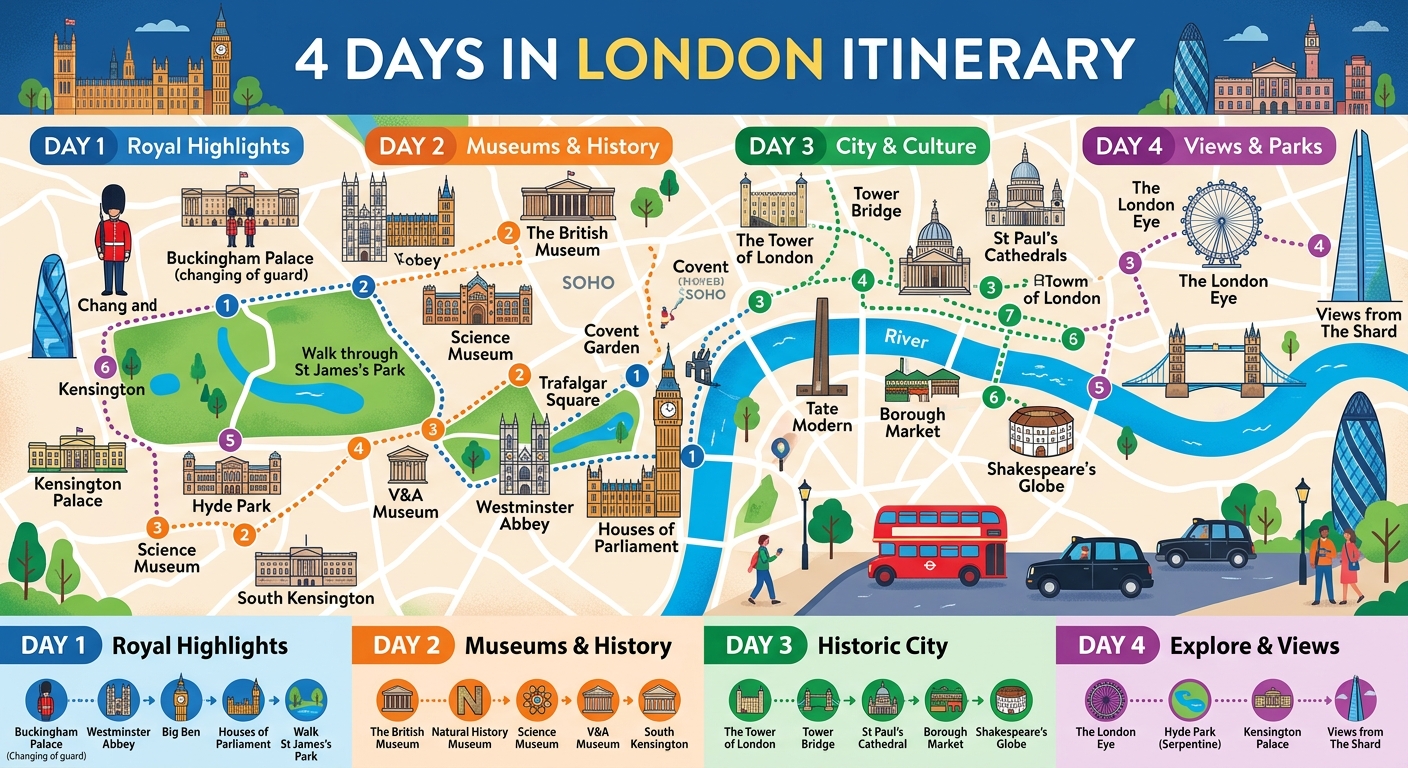
Before you start locking in tickets, it helps to understand how London works in real life. The city rewards planning, but it also rewards flexibility, because opening hours, queues, weather, and energy levels can all change the feel of a day. The core rule is simple: cluster by neighborhood, book the few things that truly need booking, and leave room to move the order around if the weather shifts or you’re tired. That one habit saves visitors more time than almost anything else.
We also want to be honest about pacing. Four days is enough for a great trip, but it is not enough to treat London like a museum crawl from dawn to midnight. You’ll enjoy the city more if you build in coffee breaks, one proper lunch, and at least one lower-pressure evening. That’s especially true if you’re arriving from North America or anywhere with a big time difference, because jet lag can make your first day feel shorter than it looks on paper.
Best time of year to follow this itinerary
Spring is one of the nicest times for this itinerary because parks like St James’s Park, Hyde Park, and Kensington Gardens feel especially fresh, and daylight keeps the city lively into the evening. Summer gives you the longest days and the most outdoor energy, but it also brings bigger crowds, more competition for restaurant tables, and a higher chance that timed-entry attractions sell out. Autumn is a sweet spot for many travelers because walking weather is comfortable, theater season is active, and the parks start to turn beautiful again. Winter brings shorter days, but also festive lights, cozy pubs, Christmas markets, and a stronger case for museum-heavy planning.
If you’re coming in 2025-2026, the biggest seasonal difference is how much you want to lean into indoor versus outdoor time. Summer is better for river walks, rooftop drinks, and late dinners; winter is better for galleries, covered markets, and shows. We’d still use the same four-day skeleton in every season, but we’d change the order of outdoor and indoor stops depending on the forecast. Always check official venue websites on the day of your visit, especially around holidays, school breaks, and special events.
How to handle jet lag and arrival day
If you land in London on the morning of Day 1, resist the urge to go full tourist from the second you drop your bags. A lighter first day is almost always the smarter move, especially if you’re crossing multiple time zones. Start with one major area, one seated meal, and one optional evening activity rather than trying to do every landmark before dinner. Your photos and your mood will both be better if you’re not exhausted by 3 p.m.
From experience, the best arrival-day approach is to stay close to your hotel after landing, take a walk, get coffee, and use the rest of the day to reset your body clock. If you’re arriving after an overnight flight, consider moving Buckingham Palace or a museum-heavy stop to later in the trip and keeping the first evening very easy. This also gives you a buffer if your luggage is delayed or your arrival time shifts.
Booking strategy
You do not need to prebook every minute of a 4-day London trip, but you should book the experiences that are most likely to sell out or have inconvenient queues. That usually means major West End shows, timed-entry attractions like the London Eye, popular restaurants, river cruises on busy dates, and some special exhibitions. If you’re visiting during peak season or school holidays, the planning window matters even more. Some attractions can be booked same-day during quiet periods, but it’s not worth gambling if you have a tight schedule.
For 2026 planning, we’d recommend checking official venue pages about two to six weeks ahead for daytime attractions and a bit earlier for theater. If you want a particularly good dinner near a show, reserve that too, because spontaneous table hunting before curtain time can make the evening feel rushed. One underrated trick is to book a late afternoon slot for a museum or river cruise, then keep dinner flexible afterward. That creates an elegant transition from sightseeing into nightlife.
Transit basics for visitors
London’s transit network is excellent, and the easiest payment method for most visitors is contactless tap-in, whether that’s a card or mobile wallet. Oyster still works, but for short trips, contactless is usually simpler and just as convenient. The Tube is fastest for longer hops, buses are better when you want to see the city, and walking is often the best option when two stops are close and the weather is pleasant. The Elizabeth line is especially useful for fast cross-city movement if your route happens to match it.
For scenic travel, the river matters more than many first-time visitors realize. Uber Boat by Thames Clippers can be a fun and practical way to move between areas like Westminster, Bankside, and Tower, especially if you want a break from underground tunnels. If you’re carrying luggage or traveling with kids, consider routes with fewer transfers and more straightforward stations. And remember that sometimes a 15-minute walk beats a 5-minute Tube ride once you factor in stairs, platform waits, and crowding.
Day 1: Westminster, Buckingham Palace, and the Classic Central London Introduction
Day 1 is all about the iconic heart of London: Westminster, the royal core, and the classic postcard sights that people picture before they ever arrive. This is the day to ease into the city with some of the most recognizable landmarks in the world, while keeping the walking route sensible and the pressure low. We like this as a first day because it gives you the “yes, I’m really in London” moment without requiring you to run all over town.
The smartest approach is to start around Westminster, move through St James’s Park toward Buckingham Palace, then finish in Trafalgar Square and Covent Garden. That keeps you in a compact part of central London and sets you up nicely for dinner, theater, or a relaxed evening in Soho. If you’re arriving tired, you can even trim the afternoon and keep the whole day to a manageable loop. If you’re energized, add an interior visit or a longer museum stop later in the day.
Morning: Westminster and the royal core
Start with Big Ben, the Houses of Parliament, and Westminster Abbey exterior views, because this cluster gives you the best first impression of ceremonial London. If you want to go inside Westminster Abbey, check the official site in advance for current hours and ticket rules, since services, special events, and holiday periods can affect access. Even if you don’t enter, the exterior and surrounding square are worth time because the architecture and sightlines are so strong. From there, walk through Parliament Square and take a slow loop around the area rather than rushing straight past it.
St James’s Park is the perfect reset between landmarks. It gives you trees, water, and a quieter rhythm before you head toward Buckingham Palace, and it is one of the best places to stop if you’re traveling with kids or you simply need a breather. From experience, this is a good place to pause for coffee or a quick snack if jet lag hits early. You’ll also get a better sense of the city’s scale when you move from the heavy stone of Westminster to the softer, greener royal parks.
Late morning: Buckingham Palace and nearby landmarks
Buckingham Palace is one of those stops that can feel underwhelming if you treat it like a 90-second photo op, so it’s better to pair it with The Mall, St James’s Park, and maybe one of the nearby royal attractions if you have the energy. The Changing of the Guard remains one of the most requested experiences, but timing changes, crowd levels vary, and the route can be packed on busy days. Always verify the current schedule on the official royal or tourist information pages before you plan your morning around it.
If you’re especially interested in the royal angle, consider whether the Royal Mews or the Queen’s Gallery fits your pace and budget, because those make the area feel more complete. Victoria Station is also nearby, which makes it a practical place to regroup, grab a snack, or shift plans if the weather turns. This part of the day works best when you think in terms of a cluster rather than a single monument. That way you get the whole royal atmosphere, not just a line outside a fence.
Lunch and a reset break
Take lunch seriously on Day 1, because a seated break can completely change how the afternoon feels. Nearby options in Victoria, St James’s, or around Trafalgar Square include pubs, casual cafes, and quick-service spots depending on your budget and mood. A pub lunch is a great London introduction because it gives you a real meal, a chance to sit down, and an easy way to avoid the temptation to overplan. If you’re traveling with people on different schedules or energy levels, lunch is also the best time to regroup and decide whether the afternoon should be museum-heavy or more casual.
From an itinerary perspective, a proper lunch is not wasted time; it’s pacing insurance. We’ve seen too many travelers attempt to squeeze in too much before their first sit-down meal, only to lose the whole afternoon to fatigue. If you’re doing a show that evening, especially in the West End, this reset matters even more because you want enough energy to enjoy the performance. Think of lunch as the moment when your London trip becomes sustainable.
Afternoon: Trafalgar Square, National Gallery, and Covent Garden
Trafalgar Square and the National Gallery are a natural pairing, and they give you a strong cultural layer without requiring you to cross the city. The National Gallery is one of the best free attractions in London, and it works especially well if the weather is rainy or if you want a more relaxed afternoon. You do not need to see every room; even a targeted visit of one to two hours can feel satisfying if you choose a few masterpieces and keep moving. The square itself is lively, central, and an easy photo stop before you continue into Covent Garden.
Covent Garden adds street performers, shopping, and a much more playful atmosphere, which is why we like it as part of day one rather than as a separate standalone mission. If you want a lighter walking day, you can simply browse the market, have tea or coffee, and enjoy the atmosphere. If you want a fuller cultural day, add a more focused gallery visit or extend your stroll through the nearby theater district. This area is especially good for couples and groups because it naturally bridges sightseeing and evening entertainment.
Evening option: West End show or relaxed Soho dinner
Your first night is the best time to decide how much energy you really have left, and that determines whether you book a West End show or keep dinner simple in Soho. If you’re feeling strong, a theater night is one of the most rewarding things to do in London, because it gives you a distinctly local entertainment experience rather than another sightseeing stop. West End productions range from long-running musicals to newer plays, and it’s smart to book ahead, especially on weekends and during school holidays. If you prefer comedy, cabaret, or live music, London has plenty of alternatives that can be easier to fit around jet lag.
If you’re tired, don’t force a huge night out. Soho is ideal for a more flexible dinner because you can eat well without locking into a huge schedule, then head back early or continue to a low-key bar. We like this as a first-night choice because it lets you enter London’s nightlife without exhausting yourself. For travelers seeking near-me entertainment, the central theater and comedy clusters are among the easiest parts of the city to discover on Gidly.
| Day 1 Activity | Time Needed | Cost Range | Prebook? |
|---|---|---|---|
| Westminster / Abbey area | 1.5-3 hours | Free exterior / paid interior | Recommended for Abbey |
| Buckingham Palace area | 1-2 hours | Free exterior / paid extras | Sometimes for interiors |
| National Gallery | 1-2.5 hours | Free | Usually no |
| West End show | 2.5-3 hours | Varies widely | Yes |
Day 2: South Bank, the Thames, and London’s River-View Highlights
Day 2 is one of the prettiest days in the whole itinerary because it follows the river and gives you a natural blend of scenery, culture, and relaxed walking. The South Bank route is one of the easiest parts of London to enjoy as a visitor because it’s visually rich, fairly intuitive to navigate, and full of places where you can pause without losing the flow of the day. If Day 1 was classic London, Day 2 is the city’s postcard-with-motion version.
We like this day because it can be as packed or as light as you want. You can make it family-friendly, museum-heavy, food-focused, or river-cruise oriented depending on your mood and the weather. It also gives you a chance to understand London’s geography in a way that maps alone don’t really capture. Once you’ve walked the Thames path and crossed a couple of bridges, the city starts to make much more sense.
Morning: London Eye, South Bank promenade, and river landmarks
Start near the London Eye if you want one of the most recognizable skyline views in the city. Whether you ride it depends on your budget, your tolerance for queues, and how much you like observation attractions, but it’s a classic for a reason. If you’re going to do it, book timed entry in advance, especially during peak travel periods or school holidays. If you’d rather skip the ride, the area still delivers strong views from the promenade, Westminster Bridge, and the riverside paths.
The South Bank promenade is excellent for a morning walk because you can watch street performers, see the river, and move at a pace that feels more human than a typical sightseeing sprint. This is also a great place to stop for coffee or breakfast with a view. For photographers, early light is usually kinder than midday glare, and the angle across the Thames can make familiar landmarks feel fresh. If you’re traveling with kids, this area is lively without being too complicated, which makes it one of the easiest family-friendly London days.
Midday: Tate Modern, Shakespeare’s Globe, or Borough Market
By midday, choose your own direction based on your interests. Tate Modern is the obvious option if you want world-class contemporary art and a free cultural stop that can absorb a couple of hours without feeling heavy. Shakespeare’s Globe is ideal if you want a theater-and-history angle, and it’s especially interesting if you care about performance in its original London context. Borough Market, meanwhile, is the move if your real priority is food, snacks, and a very London market atmosphere. All three are strong, and the best choice depends on whether you want indoor culture, live-performance heritage, or lunch-first momentum.
From experience, Borough Market is one of the best practical lunch stops in the city because it gives your group options, and everyone can eat at their own pace. It is especially useful on a day when you don’t want a long sit-down restaurant meal. Tate Modern works better when the weather is bad or when you want a slower, air-conditioned reset. Shakespeare’s Globe fits best if you enjoy unique cultural storytelling and want a more refined entertainment layer than the average tourist route.
Afternoon: Bridge-to-bridge walk
The bridge-to-bridge walk is one of the best ways to understand London visually. Start around Millennium Bridge for views of St Paul’s Cathedral, then keep moving east along the river or angle across to the City of London depending on your energy. Tower Bridge is the big finale in this part of the itinerary, and it’s worth approaching it on foot rather than only seeing it from a distance. The bridge, river, and skyline interaction is what makes the area memorable.
If you want more movement without more walking, this is where a short river cruise or a hop on Uber Boat by Thames Clippers can be brilliant. It adds a practical transport layer while also giving you a cleaner view of the city than the Tube ever could. For visitors who like to photograph landmarks without spending the whole day rushing between them, this is one of the best tradeoffs in London. You get the iconic architecture, the water, and a bit of rest all at once.
Evening: dinner with a view or nighttime Thames walk
After sunset, the river corridor becomes even more attractive because the skyline lights up and the crowds thin out a little. A dinner with a view near the South Bank, Bankside, or across the river can be a fantastic finish to the day, especially if you’ve spent the afternoon walking. If you prefer a lower-cost option, a nighttime Thames walk still feels special and costs very little. London is surprisingly good after dark when you stay in active central zones and don’t try to overcomplicate the route.
This is also a good moment to pivot into entertainment if you skipped a show on Day 1. You could head back toward the West End for theater, or choose a nearby bar, cocktail spot, or live-music venue depending on your travel style. The South Bank at night is great for couples and solo travelers because it feels lively without being chaotic. For Gidly users searching for things to do tonight near the river, this is exactly the kind of area where live events and dining can be layered together easily.
Day 3: Choose Your London Personality — Museums, Neighborhoods, or Hidden Gems
Day 3 is where your trip becomes personal. Instead of forcing everyone onto the exact same route, this day lets you choose the London personality that fits your mood, energy, and travel style. Some travelers want a museum masterpiece, some want street art and food, some want elegant streets and markets, and some want a more local-feeling day in a green, scenic district. London is excellent at all of those, so the right move is to pick one lane and do it well.
This flexibility is also the reason London works so well for repeat visitors. The classic monuments are only part of the city; the real charm starts when you spend time in a neighborhood long enough to notice the rhythm. We strongly recommend resisting the temptation to do all four versions of the day in one go. Pick one, commit, and let the rest become future-trip material.
Option A: Museum-heavy day in South Kensington
If you love museums, South Kensington is one of the easiest and most rewarding parts of London to spend a full day. The British Museum is technically in Bloomsbury, but the Natural History Museum and Victoria and Albert Museum make South Kensington a true museum zone, especially for first-timers and families. The Natural History Museum is great for its architecture and broad appeal, while the V&A is ideal if you like design, fashion, decorative arts, or beautiful galleries. Harrods is nearby if you want an upscale department-store stop, even if it’s just to browse.
This route works best when you don’t try to see all museums in full. Choose one anchor museum, add a second if you have energy, and leave room for coffee or a proper lunch. We recommend this option for rainy days, families with kids, and travelers who prefer a more contained, indoor experience. It’s also a good choice if you want to keep the evening light, because museum days can be pleasantly calming compared with the more visual but busier central sightseeing days.
Option B: East London culture and food
East London gives you the creative side of the city, especially around Shoreditch, Spitalfields, and Brick Lane. Shoreditch is where you go for street art, independent shops, and a younger, more experimental atmosphere. Spitalfields Market gives you a food-and-shopping stop that’s easy to mix into a relaxed day. Brick Lane remains one of the most recognizable areas for casual food, vintage browsing, and edgy nightlife, although some parts feel more polished now than they did years ago. That evolution is part of London in 2025-2026: more curated, more bookable, and often a bit less wild than the old stereotype.
This is a great day for groups and solo travelers who like spontaneous discovery. You can start with brunch, drift through street art lanes, browse a market, then end with dinner or live music. Compared with central London, the pace feels less formal and more playful. If you want a more modern entertainment layer—comedy, pop-up events, small exhibitions, or ticketed nightlife—East London often has the kind of listings you’ll want to check on Gidly before you head out.
Option C: West London elegance
Notting Hill, Kensington, and nearby West London areas give you a slower, prettier day with colorful streets, garden squares, and a more residential feel. Portobello Road Market is the obvious draw, especially if you like antiques, vintage shopping, and weekend browsing. Notting Hill also works well for coffee, brunch, and low-pressure wandering, which makes it a nice choice for couples or travelers who’ve already done enough heavy sightseeing. Kensington Gardens adds a green, scenic break if you want to balance out the shopping and walking.
This route is ideal if you don’t want your London trip to feel too landmark-heavy. It’s also a nice way to experience the city’s design and neighborhood character, not just its monuments. We like this choice for people who want beautiful photos, boutique browsing, and a relaxed lunch rather than a museum marathon. If your idea of a good day is elegant but low-stress, this is your neighborhood.
Option D: Greenwich or Hampstead for a more local-feeling day
Greenwich and Hampstead both offer a more local-feeling London experience, but they do it in very different ways. Greenwich gives you maritime history, park views, and a strong sense of place, plus easy scenic breaks by the river. It’s especially good if you want to combine museums, the Cutty Sark area, and a park climb with skyline views. Hampstead is more village-like, with leafy streets, independent cafes, and the chance to visit Hampstead Heath for a sweeping panorama. Both areas are excellent for repeat visitors who want to step away from the standard tourist loop.
If you choose one of these, you’re trading quantity for atmosphere, and that’s usually a great deal. You may see fewer famous sights, but you’ll experience the city in a way that feels lived-in rather than staged. For travelers who care about variety, these neighborhoods can become the most memorable part of the trip. They also show why London is such a strong entertainment city beyond its icons: the city has room for park walks, local pubs, special events, and calmer cultural stops all within the same journey.
Day 4: Flexible Final Day for Your Travel Style
Day 4 should not be the day you burn out. It should be the day that makes your trip feel complete, whether that means one more iconic landmark, a great final meal, a family-friendly activity, or a relaxed morning in a favorite neighborhood. This is where the best London itineraries become personalized rather than generic. Your flight time, your interests, and your energy level should all shape the finish.
We like to think of the final day as a choose-your-own-adventure chapter. If you still want big sights, go for Tower of London or a final museum. If entertainment matters most, make it a show, comedy, or live music day. If you’re traveling with kids, prioritize something easy and interactive. If you just want to leave London feeling happy rather than exhausted, keep the pace soft and scenic.
If you want more icons
For travelers who are still hungry for classic London, the Tower of London is the strongest final-day icon because it combines history, architecture, and a dramatic riverside setting. St Paul’s Cathedral is another excellent option if you haven’t already gone inside or if you want a different perspective on the city’s skyline. A second museum can also work, especially if you skipped one of the big institutions earlier in the trip. The key is not to repeat the same kind of experience three days in a row unless that is genuinely your interest.
If you choose a more iconic finale, try to keep transportation simple and stack your stops so they stay within the same area. This day can quickly become tiring if you chase the city’s top three landmarks across different quadrants. We’d rather see you do one major attraction well and enjoy lunch nearby than tick off two rushed stops and spend the afternoon on the Tube. Quality beats quantity on Day 4 almost every time.
If you want entertainment
If your trip is really about culture plus nightlife, Day 4 is the day to go heavy on entertainment. An afternoon matinee, a comedy club, a live music venue, or an immersive experience can be a terrific capstone, especially for couples or friends. London’s event scene in 2025-2026 is increasingly about flexible booking and layered plans, which means you can pair a late afternoon activity with dinner and still have a strong night out. That makes the final day feel more like a local night than a museum exit ramp.
For travelers asking where to find near-me entertainment in London tonight, this is exactly where a live discovery platform matters. Instead of pre-deciding every possible evening, keep one slot open for what’s actually happening when you’re in town. That’s especially useful in neighborhoods like Soho, the West End, Camden, and Shoreditch, where the options can shift quickly. You might discover a special performance, a pop-up comedy night, or an exhibition that wasn’t on your radar when you booked the trip.
If you want family-friendly fun
Families often do best on the final day with something low-stress and interactive. The Natural History Museum remains a reliable favorite, but you could also choose a park, a river activity, a hands-on museum, or an aquarium depending on ages and attention spans. The biggest family mistake is trying to squeeze in one more major landmark when everyone is already tired. A happier move is to build in play, snacks, and one scenic break so the day ends with good memories instead of logistical friction.
If your kids still have energy, an easy river walk or a market visit can be a good final bonus. If they’re done, don’t fight it. London is a city where a simple afternoon in a park or café can still feel worthwhile, especially if you’ve already done the key landmarks. Families generally leave happier when the schedule is less ambitious and more responsive to mood.
If you want a slower final day
For many travelers, the best last day is a calm one: breakfast, a neighborhood wander, some souvenir shopping, and one final scenic stop before heading to the airport or train. This approach works especially well if your flight is in the evening or if you want to avoid the stress of a packed departure day. Choose a neighborhood you liked earlier in the trip, return to a favorite market or café, and let the city breathe a little. That’s often how a trip ends well.
A slower final day also gives you room for practical tasks like packing, checking out of your hotel, and storing luggage. If you’re staying near a major station or central area, you can easily fit one last lunch or coffee before departure. It’s not the most dramatic version of London, but it’s one of the most comfortable—and comfort is often what makes the final memory stick.
Best Things to Do in London in 4 Days, Ranked by Priority
If you only have four days, not every attraction deserves equal time. The best itineraries are selective, and that means knowing what belongs at the top of the list and what can be swapped depending on your interests. London has so much to offer that the hardest part is often deciding what to leave out. This section gives you a practical ranking so you can focus on the experiences that truly justify the time, energy, and occasional ticket cost.
Our ranking is based on a mix of first-time visitor value, visual impact, neighborhood fit, and how often travelers tell us they felt glad they didn’t skip something. We also weighed whether the stop helps the trip as a whole, not just whether it is famous. In other words, some places earn their spot because they are iconic, while others earn it because they make the rest of the itinerary work better.
The absolute must-see landmarks
The highest-priority landmarks are Big Ben, Westminster Abbey, Buckingham Palace, the Thames and its bridges, Tower Bridge, the London Eye, and St Paul’s Cathedral views. These are the places that give your trip its unmistakable London identity. If you miss one of them, your trip can still be excellent, but if you hit all of them, you’ll feel like you truly saw the city’s core. The most important thing is not to visit them randomly; it’s to tie them into sensible walking or transit clusters.
We’d also place Trafalgar Square and Parliament Square high on the list because they’re easy to include and help orient you visually. The exterior experience of some landmarks is just as worthwhile as the inside visit, especially if you are short on time or traveling on a budget. That’s one reason London remains such a good city for mixed-cost itineraries. You can build a trip around major icons while paying for only a few of them.
The best museums and galleries
London’s major museums are not just filler for rainy days; they are destination-level experiences. The National Gallery is the easiest free art stop to include in a short trip, while the British Museum gives you the huge civilization-and-history scale that many travelers want in London. The Natural History Museum is great for families and architecture lovers, and the Victoria and Albert Museum is a superb choice for design, fashion, and decorative arts. Tate Modern stands out if you prefer contemporary art or a more modern cultural tone.
Because your time is limited, the best strategy is to choose one anchor museum and one optional museum only if the day is flowing well. You do not need to “finish” a museum to have a successful visit. In fact, one of the best ways to enjoy London is to leave yourself wanting a little more, rather than forcing yourself through eight galleries you barely remember. Museums become more enjoyable when they’re paced like experiences, not homework.
The best scenic walks and viewpoints
If you love city walks, London has more than enough to make the trip feel cinematic. The Thames Path, South Bank promenade, bridge-to-bridge walks, St James’s Park, Kensington Gardens, Hyde Park, Greenwich Park, and Hampstead Heath are all excellent options. A scenic walk is valuable not just for the view, but because it helps you absorb the city at street level, which is where London’s character really shows up. A bridge view or skyline spot is memorable on its own, but it’s even better when it comes after a market, museum, or lunch stop.
For repeat visitors, a park or river walk may actually be more memorable than another famous building. It’s the difference between seeing London and feeling it. That is especially true at sunset or just after sunrise, when the city is quieter and the light is kinder. If you are only going to add one non-ticketed experience to your list, make it a scenic walk.
The best entertainment add-ons
London’s entertainment layer is what turns a good trip into a great one. The West End is the obvious add-on, but comedy clubs, cabaret, live music, and immersive shows are also major parts of the city’s identity. In 2025-2026, travelers increasingly want evening plans that are bookable, flexible, and neighborhood-based instead of simply choosing the biggest show. That shift makes sense: a great dinner plus a strong live event often feels more satisfying than spending three hours queueing for a single attraction.
If you’re deciding what to add, think about your energy and who you’re traveling with. Couples usually enjoy a show or a nicer dinner; friends often want something social and lively; solo travelers may prefer smaller venues or events with a relaxed atmosphere. Entertainment is also one of the easiest ways to make London feel current rather than just historical. That’s why we strongly recommend building at least one evening around something live.
| Attraction | Type | Time Needed | Worth Prebooking? |
|---|---|---|---|
| Westminster Abbey | Historic landmark | 1.5-2.5 hours | Yes |
| National Gallery | Museum | 1-2.5 hours | No |
| South Bank walk | Scenic route | 1-3 hours | No |
| West End show | Entertainment | 2.5-3 hours | Yes |
London by Neighborhood: Where to Spend Your Time
London is best experienced in clusters, not as a giant blur of famous stops. When you think neighborhood by neighborhood, the city becomes much easier to plan and much more enjoyable to explore. Westminster feels ceremonial, South Bank feels scenic and cultural, the City of London feels historic and businesslike, Soho feels energetic, Shoreditch feels creative, South Kensington feels polished, and places like Greenwich, Hampstead, and Richmond give you a gentler, more local rhythm. The trick is to match neighborhoods to the kind of energy you want that day.
This matters because London isn’t just about what you see; it’s about the atmosphere between stops. A great itinerary needs those in-between moments as much as the big attractions. We’ve found that many travelers remember the neighborhood feel as much as the landmark itself, especially when they pick one area to linger in rather than racing through six. That’s why this section is so useful for travelers deciding where to stay, where to eat, and where to spend their evenings.
Westminster and St James’s
Westminster and St James’s are the ceremonial face of London, with Big Ben, Parliament, Westminster Abbey, royal parks, and Buckingham Palace all in or near the cluster. This is the area that gives first-timers the strongest “I’ve arrived” feeling. It’s also one of the easiest areas to build into a 4-day itinerary because so many core sights sit close together. If your trip is short, spending time here is almost never a mistake.
St James’s adds a slightly calmer, more polished texture than the most crowded tourist corners. That makes it a useful place to slow down, especially early in the day or between major monuments. The area is ideal for classic sightseeing, but it can also work for a smart lunch or a more elegant coffee break. We like it for visitors who want iconic London without too much noise or improvisation.
South Bank and Bankside
South Bank and Bankside are where culture, scenery, and easy walking come together. This is one of London’s most visitor-friendly districts because the river promenade connects major sights without forcing you into complicated transit. The London Eye, Tate Modern, Shakespeare’s Globe, and Borough Market all sit within a route that feels intuitive, lively, and photogenic. If you like to see a lot while still staying mostly on foot, this is one of the best areas in the city.
At night, the area becomes even more appealing because the river lights and bridge views create a strong atmosphere. It’s also a good fit for families, couples, and travelers who like a mix of indoor and outdoor stops. The only real downside is crowding at peak times, so arriving earlier in the day often makes the experience smoother. Still, for a 4-day trip, South Bank is a must-consider neighborhood.
City of London and Tower Hill
The City of London gives you old and new London at once: ancient history, financial towers, the Tower of London nearby, and St Paul’s Cathedral not far away. It’s one of the most visually interesting parts of the city if you like contrasts between medieval and modern architecture. This area can feel a bit quieter on weekends than weekdays, which is something to keep in mind when planning your visit. If you want the best atmosphere, time your walk carefully.
Tower Hill and the surrounding riverfront work especially well for travelers who want a history-heavy day with strong views. It’s also one of the best areas for bridge-to-bridge walking and river transport. If you only have a short window, this area deserves attention even if you don’t do every paid attraction. The architecture and riverside setting are powerful enough on their own.
Covent Garden, Soho, and Leicester Square
Covent Garden, Soho, and Leicester Square are your best bets for dining, shopping, theater, and late-night energy. This is the part of London where many visitors naturally end up for dinner and a show, and for good reason. Covent Garden gives you a lively daytime market feel, Soho offers more nightlife and restaurant variety, and Leicester Square puts you near the theater district with easy access to entertainment. If you want to stay central and maximize convenience, this cluster is hard to beat.
The downside is that these areas can be busy and tourist-forward, so you’ll want to choose your spots carefully. Still, for a short trip, busy is often helpful because it means many options in a small radius. We especially like this area for people who want a flexible evening because you can pivot from dinner to drinks to a show without a lot of transit. It’s one of the strongest neighborhoods for travelers who care about entertainment first.
Shoreditch, Spitalfields, and Brick Lane
Shoreditch, Spitalfields, and Brick Lane are where London’s creative energy shows up most clearly. Expect street art, independent cafes, vintage shops, markets, and a more contemporary, less formal atmosphere. This is the area to choose if you want your trip to feel current and somewhat local rather than purely monumental. For food lovers and nightlife fans, the density of options can be excellent, especially in the evening.
In 2025-2026, this area also reflects the city’s shift toward more curated, bookable experiences. Pop-ups, small exhibitions, special food events, and flexible nightlife plans are very much part of the mix here. It’s a strong neighborhood for groups and solo travelers because there is plenty to browse without needing a rigid agenda. If your ideal day includes wandering, eating, and maybe discovering a new event, Shoreditch belongs on your list.
South Kensington, Kensington, and Chelsea
South Kensington, Kensington, and Chelsea are the polished, museum-friendly, elegant side of London. This is where you’ll find the Natural History Museum, the V&A, and a generally upscale vibe that can be very pleasant for a slower day. It’s especially good for travelers who like clean streets, beautiful architecture, and easy access to major indoor attractions. If you want to combine culture with a nice lunch and a relaxed shopping stop, this cluster is excellent.
The area also works well for families because the museums are predictable, popular, and relatively easy to structure around. It’s not the wildest part of London, but that’s the point. You come here for comfort, quality, and a dependable fallback if the weather is bad. For short trips, dependable neighborhoods can be just as valuable as flashy ones.
Notting Hill, Paddington, and West London
Notting Hill gives you colorful streets, Portobello Road Market, and a soft, photogenic neighborhood feel that many visitors love. Paddington is more of a transport-friendly base area, but it can be convenient if you want easy access to multiple parts of the city. West London in general is good for a gentler pace, especially if you want to mix markets, cafes, and attractive streets instead of major museum blocks. It’s a strong choice for travelers who’ve already seen the obvious icons and want atmosphere.
This area is often best on a day when you’re not trying to move too quickly. It rewards lingering, browsing, and spontaneous stops. If you’re a couple or a solo traveler looking for a mellow but beautiful part of the city, West London can be a highlight rather than a filler. It’s also a nice place to spend a morning before heading somewhere more lively for dinner.
Greenwich, Hampstead, Richmond, and other local-feel areas
Greenwich, Hampstead, and Richmond are some of the best choices if you want a local-feeling day that still has plenty to do. Greenwich combines history, river atmosphere, and parks with a distinctive sense of place. Hampstead feels village-like and elegant, with Hampstead Heath offering one of the best skyline views in London. Richmond gives you riverside calm, greenery, and a more suburban, upscale feel that can be a lovely escape from the central buzz.
These areas are especially good for repeat visitors, slower travelers, and people who want more breathing room. They’re also excellent if your group doesn’t want to spend the entire trip in the busiest central zones. We often recommend one of these on Day 3 or Day 4 if you’ve already done the classic sights and want a more memorable neighborhood finale. In many ways, these are the places that make London feel like a city you could return to many times.
| Neighborhood | Vibe | Best For | Typical Spend |
|---|---|---|---|
| Westminster | Iconic, ceremonial | First-timers | Medium-high |
| South Bank | Scenic, cultural | Families, couples | Low-medium |
| Soho | Energetic, nightlife | Friends, foodies | Medium-high |
| Shoreditch | Creative, trendy | Solo, groups | Medium |
Where to Eat, Drink, and See a Show in 4 Days
Food and entertainment are not side notes in London; they are part of the trip’s rhythm. A strong itinerary should tell you not just what to see, but where to break for breakfast, how to make lunch easy, and when to book a show or live event so your evenings feel intentional. London is one of the best cities for “plan a little, leave room for a lot,” which is exactly why the eating-and-entertainment layer matters so much.
We also know from experience that the wrong meal in the wrong place can throw off a day more than people expect. A slow lunch too far from your next attraction, or a last-minute dinner hunt before a show, can create avoidable stress. On the other hand, the right market lunch, pub stop, or theater-district dinner can make the whole itinerary feel smoother. This section helps you connect the dots.
Best areas for breakfast and brunch
For breakfast and brunch, the best strategy is to stay near your first stop of the day. In Westminster or St James’s, grab coffee and a pastry close to your morning landmark route. On the South Bank, choose a riverside cafe or a place near your hotel so you can start walking without backtracking. In South Kensington, brunch is easy because the museum district has many casual, reliable options. In Shoreditch, you’ll find more trend-forward cafes, brunch spots, and bakeries with a creative edge.
Breakfast should support the itinerary, not become a separate event that eats into sightseeing time. If you like a slower morning, plan for it, but don’t let brunch become a two-hour detour unless that is actually the point of your trip. London does brunch well, but the best meals are the ones that fit your day. Our team tends to favor proximity and comfort on travel mornings, especially when there’s a major attraction or timed ticket ahead.
Best lunch stops by day
Day 1 lunch works well in Victoria, St James’s, or near Trafalgar Square because you’re in the middle of the royal-and-central cluster. Day 2 is perfect for Borough Market or a casual South Bank stop because the area is built for walk-and-eat flexibility. Day 3 depends on your personality: South Kensington for museum breaks, Spitalfields or Brick Lane for East London food, or Portobello Road if you’re in Notting Hill. Day 4 should be the easiest lunch of the trip, not the most ambitious.
The best lunch stops are the ones that match your pace. Markets are great if you want variety and quick service, but they can also be crowded. Pubs are often ideal because they’re familiar, filling, and good for regrouping. If you’re traveling with mixed tastes or dietary needs, London is very accommodating, but the earlier you decide the better. That’s especially true around popular market zones where you may want to avoid peak-time congestion.
Best dinner neighborhoods
For dinner, Soho is one of the most dependable choices because it sits near theater, bars, and central transit. Covent Garden is equally useful if you want lively streets and easy access to entertainment. Shoreditch is your pick for more contemporary or creative dining, while South Bank and Bankside work well if you want a dinner with river atmosphere. In Notting Hill or Kensington, dinner tends to feel a little calmer and more residential, which can be lovely after a packed sightseeing day.
We suggest choosing dinner neighborhoods based on what comes next. If you have a show, stay central and close. If you’re done sightseeing and want to linger, choose atmosphere over convenience. If you’re with kids, look for an early, straightforward dinner that doesn’t become a logistical project. The city is big, but good planning makes dinner feel effortless.
West End shows, comedy, and live music
The West End is one of the most rewarding entertainment add-ons in London, especially for first-timers and couples. But it’s not the only option. Comedy clubs, live-music venues, cabaret, and immersive events often fit better into a 4-day trip, especially if you want something current and flexible. In 2025-2026, more travelers are actively mixing sightseeing with live entertainment rather than treating evenings as leftover time. That’s a smart shift because London’s event scene is one of its best reasons to visit.
If you’re deciding whether to do a show, ask yourself two things: how much energy you’ll have that evening, and whether you’d rather sit quietly or stay social. A major musical can be perfect after an easier day. A comedy club or live set can feel better if you want something less formal and more spontaneous. Gidly’s live discovery approach is especially useful here because it can help you find what’s on now, not just what’s famous.
Budget-Friendly 4 Days in London: Free and Low-Cost Options
London has a reputation for being expensive, but a smart itinerary can actually keep costs very manageable. Many of the city’s best attractions are free, and some of the most memorable experiences—parks, river walks, market browsing, and landmark exteriors—cost nothing at all. The key is to know where to splurge and where to save. If you do that well, you can have a genuinely rich 4-day trip without blowing your budget.
We also think budget travel in London is easier now than many first-timers expect, especially when you use contactless transit, free museums, and low-cost lunches. The biggest cost traps are unplanned taxis, expensive restaurant meals near tourist hotspots, and tickets you bought out of FOMO rather than actual interest. This section helps you avoid those mistakes while still enjoying the city fully.
The best free attractions
Some of the best free attractions in London include the National Gallery, Tate Modern’s main collection areas, the British Museum, the Natural History Museum, Hyde Park, St James’s Park, Kensington Gardens, the South Bank walk, and plenty of public architecture and landmark exteriors. Free does not mean boring here; in many cases, free means “world-class and easy to fit in.” You can build half a London itinerary around free stops and still feel like you did something major every day.
Markets are also great for budget travelers because they offer atmosphere without requiring a full restaurant bill. Borough Market, Spitalfields, and Portobello Road are all useful for browsing and low-cost bites. If you’re traveling with a group, the flexibility of markets can prevent arguments over food preferences and prices. That’s part of why they’re so useful in a short city trip.
Cheap transit and walking hacks
Use contactless payment instead of worrying too much about travel cards unless you have a very specific use case. The Tube is efficient, but the bus can be cheaper in the sense that it can save you from unnecessary transfer stress and gives you city views. Off-peak travel is generally more comfortable, and walking between clustered sights often beats taking a short Tube ride and then waiting underground. If you’re staying central, you may be surprised how many key stops are walkable.
Another easy saving hack is to treat the river as scenic transport rather than a separate splurge. Sometimes a riverside walk plus one boat hop gives you the same feeling as a long cruise without the same cost. For families or tired travelers, this can be especially helpful. It keeps the day interesting without piling on extra expenses.
Affordable meals and snacks
Affordable London eating is easiest when you focus on pubs, markets, bakeries, and quick-service lunch spots rather than tourist-facing sit-down restaurants in the busiest zones. Pub lunches can be especially good value because they often include a filling main, a relaxed atmosphere, and a predictable price point. Market food is another smart strategy, but you’ll want to compare stalls before committing because the difference between “reasonable” and “too expensive for lunch” can be small. Coffee, pastries, and sandwich shops can also help you keep the pace up without draining your budget.
If you’re trying to save money, one practical method is to make breakfast your cheapest meal and lunch your mid-range meal. Then reserve one nicer dinner or entertainment night for the thing you really care about. That tradeoff is usually much more satisfying than trying to keep every meal ultra-cheap and accidentally missing a special experience. London is worth one or two deliberate splurges.
What to splurge on vs. save on
We suggest splurging on one memorable paid experience, such as a West End show, a top-tier museum exhibition, a river cruise, or a landmark interior you truly want to see. These are the experiences that can make the trip feel special and distinct. Save on the rest by using free museums, parks, scenic walks, and landmark exteriors. That combination gives you a balanced trip without the “I spent all my money before day three” problem.
A simple rule: if something is uniquely London and hard to replicate later, consider paying for it. If it’s simply a view or an activity that has a free version nearby, save your money. This approach makes the itinerary more sustainable and often more memorable. You’ll come home remembering the one spectacular thing you did, not the eight little add-ons you barely noticed.
| Category | Best Free/Low-Cost Picks | Typical Cost | Best Use |
|---|---|---|---|
| Museums | National Gallery, British Museum, Tate Modern | Free | Rainy days, culture |
| Parks / Walks | St James’s Park, South Bank, Hyde Park | Free | Scenery, rest |
| Food | Markets, pubs, bakeries | £10-£25 | Lunch, snacks |
| Entertainment | Matinees, comedy, some live music | Varies | One special night |
Is the London Pass Worth It for a 4-Day Trip?
The London Pass can be worth it for a 4-day trip, but only if your itinerary is attraction-heavy and you’re genuinely planning to enter several included paid sites. If your trip is more about museums, neighborhoods, and free landmarks, a pass may not deliver enough value to justify the cost. This is one of those decisions that depends more on your actual route than on the marketing pitch. The right answer is not universal; it’s mathematical.
The easiest way to decide is to list the paid attractions you truly want to see, compare those ticket prices to the pass price, and then factor in how much time you’ll lose moving between sites. Passes are most useful when they help you stack expensive sites in the same area. If you only plan one or two major ticketed experiences, buying them separately is often smarter.
When the pass makes sense
The pass tends to make sense if you want to visit multiple paid attractions such as the Tower of London, a river cruise, a major observation deck, and perhaps one or two additional venues. It can also be useful for first-time visitors who want a lot of structure and are determined to do several famous places in one go. If you enjoy planning and are comfortable moving quickly, you may be able to get strong value out of it. Families sometimes like the predictability too, especially if the included sites align with their interests.
But value only exists if you use the pass efficiently. That means checking opening hours, route timing, and whether the included attractions are truly on your wish list. We recommend using the pass as a planning tool, not a replacement for thinking. If you do that, it can be a nice way to simplify a busy trip.
When the pass does not make sense
If your ideal London trip is slower, more neighborhood-based, or entertainment-focused, the pass usually isn’t the best fit. Travelers who prioritize free museums, scenic walks, pub time, and a West End show may not hit enough paid attractions to make the math work. The same is true if you’re visiting a lot of places that are already free or only cost a little. In that case, you could end up paying for a pass you barely use.
We also don’t love the pass for people who are prone to overbooking. It can tempt you into treating the city like a race. London becomes more enjoyable when you leave breathing room, so if a pass pushes you to over-schedule, it may create more stress than value. Sometimes the best deal is actually no deal at all.
How to build a pass-optimized route
If you do use a pass, cluster paid attractions by area so you’re not wasting time in transit. Put Westminster-area items together, pair South Bank with Bankside, and combine City of London and Tower Hill stops where possible. Build at least one meal and one rest break into each day so the plan stays realistic. You’ll get more value from fewer, better-timed entries than from sprinting across London trying to “maximize” every ticket.
It can also help to start with the most time-sensitive or queue-prone attraction in the morning. That tends to make the rest of the day smoother. If your pass includes boat rides or moving around the river, use those strategically as both transport and sightseeing. That way the pass supports the itinerary instead of dictating it.
Common mistakes with attraction passes
The biggest mistake is buying a pass without comparing actual ticket costs first. The second mistake is ignoring opening hours, which can completely change the math. Another common error is assuming the pass will make every attraction faster or less crowded, which is not always true. Passes can save money, but they can’t save bad planning.
We also see travelers overestimate how many attractions they can comfortably visit in a day. London is not a city where every included stop should be used just because it’s available. Choose the things you really want, then let the pass support that route. If you do that, you’ll avoid burnout and still make a smart financial choice.
Travel Pace, Booking, and Logistics
If you want this itinerary to actually work, logistics matter as much as the sights themselves. London is very doable in four days, but only if you pace each day realistically, check opening times, and build in a few small buffers. A good itinerary should feel like a strong suggestion, not a military operation. The best trips leave room for weather changes, snack stops, and the occasional “let’s stay here a little longer” moment.
We’ve found that most trip frustration comes from bad pacing rather than bad attraction choices. People do too much before lunch, underestimate transit time, or forget that some places are best visited early. This section exists to help you avoid those classic mistakes. The payoff is a smoother, calmer trip with less time lost to stress.
Ideal daily pacing
The best daily rhythm for London is usually a morning anchor, a lunch reset, an afternoon flex, and an optional evening add-on. The anchor is your major attraction or neighborhood block. The reset is where you eat and sit down. The flex is where you can choose between museum time, shopping, or a scenic walk. The evening add-on can be a show, a nice dinner, or simply a walk and drink somewhere central.
This rhythm works because it respects how most travelers actually feel as the day progresses. Mornings are often the sharpest, afternoons can wobble, and evenings are where you either have extra energy or need a lighter close. By thinking in blocks rather than minute-by-minute tasks, you make the trip much more adaptable. That’s one of the biggest differences between a good itinerary and a stressful one.
Opening hours and timing pitfalls
Many of London’s major attractions have best-visit windows that are earlier or later than first-timers expect. Some places are busier right after opening, while others become much more pleasant later in the afternoon. The key is to verify hours on official websites and check for seasonal changes, special closures, and holiday adjustments. In 2025-2026, more venues are also using timed entry or modifying access on busy dates, so freshness matters.
If you are trying to fit multiple top sights into one day, start early. That gives you the best chance to avoid queues and keeps the afternoon from turning into a race. Also remember that some attractions are best viewed externally even if you don’t go inside. That means you can still have a great day if one interior stop gets moved or skipped.
Getting around with luggage or kids
If you’re dealing with luggage, strollers, or young kids, plan for fewer transfers and more direct routes. The Tube is efficient, but stations can involve stairs, long walks, and crowding. Buses or taxis may be worth the tradeoff in certain situations, especially when a smoother transfer matters more than the cheapest option. For families, the most successful London days are usually the ones with predictable blocks, plenty of snack breaks, and a few open spaces like parks or river paths.
Accessibility also varies by station and attraction, so it’s wise to check official guidance before committing to a route. London is improving in this area, but it still helps to know which stops fit your needs best. If you’re traveling with children or mobility concerns, reduce the number of areas per day and stay in a narrower zone. That simple move makes the trip much easier.
Rainy-day adjustments
Rain should not derail your London itinerary; it should simply change the order of your day. Shift outdoor stops to shorter walks, move museums earlier, and use covered markets or galleries as flexible anchors. The city has so many indoor options that a rainy forecast usually only changes the mood, not the plan. If anything, rain can make museums, pubs, and markets feel even more inviting.
Our rule is to keep at least one rain-friendly backup in each day’s plan. That way you can pivot without rebuilding the whole schedule. For London, those backups are often the National Gallery, Tate Modern, the British Museum, or a good meal in a covered market. If you build that flexibility in, the weather becomes an inconvenience rather than a problem.
Seasonal Planning: What Changes in London Across the Year
Season changes London more than many visitors expect, especially when it comes to daylight, crowds, and how comfortable outdoor sightseeing feels. The same 4-day itinerary can work in every season, but the order and emphasis should shift a bit depending on when you go. If you understand the seasonal tradeoffs, you can make much better decisions about which days should be river-heavy, museum-heavy, or entertainment-heavy. That’s one of the easiest ways to make your trip feel smoother.
We’d also note that London’s event calendar feels more bookable and neighborhood-led in 2025-2026 than it did a few years ago. More visitors are choosing specific evenings, pop-ups, and timed experiences rather than just wandering aimlessly. Seasonal planning helps you benefit from that shift instead of fighting it. Here’s how to think about the year.
Spring in London
Spring is one of the most rewarding seasons for a London trip because parks and gardens look great, temperatures are generally manageable, and the city feels fresh without being overrun by summer peak crowds. This is a great time for Westminster, St James’s Park, Kensington Gardens, and river walks. You’ll still want a backup for rain, but the mix of outdoor and indoor stops tends to feel well balanced. Spring is also a strong season for photo-heavy travelers because the light is often flattering and the city’s greenery starts to wake up.
If you’re coming in spring, don’t overpack the day too tightly. The pleasant weather makes it tempting to linger outdoors, and that is often the right call. We’d especially recommend leaning into scenic walks and one or two neighborhoods with gardens or market streets. Spring suits the itinerary’s natural rhythm almost perfectly.
Summer in London
Summer gives you the longest days, which is great news if you want more flexibility for outdoor sightseeing and nightlife. It’s easier to do a later dinner, a sunset river walk, or a show followed by drinks because the city stays lively later. On the downside, major attractions can be busier, restaurant reservations become more important, and the combination of heat and crowds can make midday feel slower. Summer is the season where planning ahead pays off the most.
We’d use summer for South Bank, parks, rooftop spots, and evening entertainment. Morning starts are especially valuable, because the city can feel much more pleasant before crowds peak. If you’re visiting in summer, the right move is often to make your days slightly more compact and your evenings slightly more ambitious. That balances the season beautifully.
Autumn in London
Autumn is one of the best all-around seasons for this itinerary. The weather is usually comfortable enough for walking, the parks look beautiful, and the city’s cultural calendar often becomes more active after summer. It’s an excellent season for museums, West End shows, pub lunches, and longer neighborhood wandering. If you like a trip that feels crisp, atmospheric, and not too crowded, autumn is a fantastic choice.
Autumn also supports a more flexible itinerary because the daylight is still decent but not so long that you feel pressure to stay outside all day. We often recommend this season for couples and solo travelers who want a balanced, stylish city trip. You can still do the landmarks, but you’ll probably enjoy the local neighborhoods even more.
Winter in London
Winter is shorter on daylight but big on atmosphere. Festive lights, holiday markets, cozy pubs, and a strong case for theater make it one of the most charming times to visit. The itinerary should lean more heavily on museums, covered markets, and evening entertainment because those fit the season better. If you’re there in late November through December, the city can feel especially magical after dark.
The main adjustment in winter is not to overpromise outdoor time. Keep scenic walks shorter, cluster stops more tightly, and choose indoor attractions that make you happy regardless of the weather. Winter is also a good season to treat the final day as a soft landing: brunch, shopping, a gallery, and one nice final meal. London in winter is less about speed and more about mood, which is exactly why it can be so memorable.
Best 4-Day London Itinerary Variations by Traveler Type
The best London itinerary is the one that matches your travel style. A couple’s trip should not look exactly like a family trip, and a group outing should not feel the same as a solo adventure. London is flexible enough to support all of those needs, which is one reason it remains such a strong destination for city dwellers looking for a packed but manageable escape. The city can be grand, relaxed, romantic, social, or practical depending on how you shape it.
These scenario-based versions are not separate trip plans so much as lenses you can apply to the same four days. You’ll still use the same geographical logic, but your evening choices, pacing, and neighborhood preferences will change. That is exactly how smart city travel should work. The best itinerary adapts to the traveler, not the other way around.
For couples and date-night travelers
Couples usually do best with a balance of classic sightseeing and one especially memorable night out. The most romantic London combination is often a river walk, a good dinner in Soho or Covent Garden, and a West End show or intimate live performance. Add in a scenic park stop or a sunset bridge walk, and the trip starts to feel effortlessly atmospheric. We’d also recommend Notting Hill, South Bank, or Hampstead for slower, more romantic wandering.
If you’re planning a date-night-oriented trip, don’t overload the schedule with too many museums unless both of you genuinely love them. The city already provides plenty of visual interest. For couples, the best memories often come from the transitions: walking from one area to another, stopping for a drink, and watching the city light up at night. That mix feels very London.
For families with kids
Families should prioritize predictability, breaks, and attractions that work across different ages. The Natural History Museum, St James’s Park, South Bank, Borough Market, and a river activity are all strong options. Avoid trying to cross too many neighborhoods in one day, because that usually creates tired kids and stressed adults. Instead, choose one major attraction, one park or market, and one easy meal block.
Families often do best when they treat Day 4 as a flexible pressure-release valve. If everyone is energetic, add one more attraction. If not, turn the day into a gentle sightseeing and snack route. London is extremely family-friendly if you keep the plan realistic. The city rewards a calmer pace more than many parents expect.
For friends and groups
Friends and groups usually want variety, photo opportunities, and some entertainment after dark. Shoreditch, Soho, Covent Garden, and the South Bank all work well because they offer plenty of choices without forcing everyone to agree on one single activity. Markets and shared meals are especially helpful for groups because they let people make different food decisions quickly. A West End show, comedy night, or live music event can also be a great anchor for one evening.
When traveling with friends, the biggest risk is indecision. Pick one or two anchors each day and let the rest stay flexible. That avoids the classic “What do you want to do?” spiral. London is wonderful for groups when there’s a clear base and a bit of freedom around it.
For solo travelers
Solo travelers often enjoy London because it’s easy to move around, easy to eat alone, and easy to fill a day with genuinely interesting stops. Museums, neighborhoods, river walks, and live events all work especially well because they don’t require group coordination. Shoreditch, South Bank, and central museum zones are good choices because they’re active without being isolating. A solo traveler can also be more spontaneous, which is ideal in a city with so many current events and pop-ups.
Safety is important, of course, but London’s central areas are generally straightforward if you stay aware and use well-traveled routes. Solo nights out are often best in areas with lots of pedestrian activity and easy transit home. This is another reason Gidly-style discovery is useful for solo travel: it helps you find what’s happening near you without wasting time.
For corporate or team-building trips
Corporate groups and team-building trips usually need a balance of shared experiences and low-friction logistics. That often means one major landmark cluster, one structured cultural stop, and one dinner or show that feels memorable but not overly formal. River cruises, private tours, and curated meals can work very well because they reduce decision fatigue. The trick is to avoid overloading the team with too many standalone attractions that split people apart.
For a work group, London does especially well when you use neighborhoods to create a theme for each day. One day can feel historic, another cultural, another creative, and the final day can be social or celebratory. That gives everyone a sense of progress without making the trip feel like a slideshow of disconnected stops. It also fits the 2025-2026 preference for bookable, curated experiences.
Common Mistakes People Make on a 4-Day London Trip
Even a great city can feel frustrating if you plan it badly, and London has a few recurring trip mistakes that are easy to avoid once you know them. Most of them come from trying to do too much, underestimating transit time, or forgetting that neighborhoods matter more than checklist quantity. The good news is that these are all solvable with a little discipline. You do not need a perfect itinerary; you need a sensible one.
The biggest mindset shift is understanding that London is not a race. It’s a city where the in-between moments are part of the experience, and where the smartest itinerary often feels slightly calmer than visitors expect. If you fix the most common mistakes, your trip will instantly feel more enjoyable, more local, and less exhausting.
Trying to see too much
The number-one mistake is attempting to cover too many famous sights in too little time. People often arrive with a giant list and assume they’ll just “fit it in,” only to spend the whole trip in transit or in queue lines. Four days is enough for major highlights, but only if you accept that some things must be saved for another trip. The city is too rich to be treated like a scavenger hunt.
We strongly recommend one main area per day and one optional evening activity, not six unrelated attractions spread across London. That simple rule alone will make your trip feel twice as manageable. You’ll see more by doing less, because you’ll spend less time recovering from moving around so much.
Skipping neighborhood time
Another mistake is treating London as a list of landmarks rather than a city of neighborhoods. If you only dash from one icon to the next, the trip can feel oddly incomplete even if you technically “saw everything.” Neighborhood time is what gives London texture, whether that means browsing Covent Garden, walking in Notting Hill, or lingering in Shoreditch. These areas are where the trip starts to feel lived-in rather than staged.
Give at least one half-day to a neighborhood you can wander. That’s where the city’s personality shows up most clearly. For many travelers, that neighborhood memory becomes the best part of the whole trip.
Forgetting to book major experiences
Major theater shows, river cruises, certain museum exhibits, and timed-entry attractions can sell out or become less convenient if you leave booking until the last minute. That is especially true in peak season, on weekends, and around holidays. A loose itinerary is good; a totally unplanned one can backfire. If a particular experience matters to you, secure it early.
This is also where 2025-2026 travel behavior matters: more people are planning specific evening activities and bookable experiences, which means the best time slots go faster. If you care about a particular show or attraction window, don’t assume it’ll be available on arrival.
Ignoring weather and transport realities
London weather changes fast enough that outdoor-heavy plans can need quick adjustments. People also underestimate how long it takes to move between areas, especially if they’re not familiar with the Tube. The fix is simple: always keep a nearby indoor backup and always think in clusters. If you do that, weather stops being a trip-killer and becomes just another planning factor.
One of the smartest habits is to check the weather the night before and then decide whether to flip the order of indoor and outdoor stops. That small habit can completely improve a day. London rewards that kind of flexibility.
Frequently Asked Questions
Is 4 days enough for London?
Yes, four days is enough to see the major icons, enjoy a museum or two, walk a few great neighborhoods, and fit in at least one show or live entertainment night. You won’t see everything, but you can absolutely leave feeling like you experienced real London rather than just a list of landmarks.
What are the best things to do in London for first timers?
First timers should prioritize Westminster, Buckingham Palace, the Thames and South Bank, the National Gallery, Borough Market, and one West End show. Those stops give you the city’s history, scenery, food, and entertainment in a very efficient way.
What should I skip if I only have 4 days in London?
Skip trying to see every famous attraction, and skip long cross-city detours that don’t fit your main neighborhood plan. You can also skip duplicate experiences unless they’re truly your thing, like visiting too many similar museums or overdoing multiple observation decks.
Where should I stay for a 4-day London itinerary?
A central area with easy access to the Tube is best, especially near Westminster, Covent Garden, Soho, South Bank, or South Kensington depending on your style and budget. Staying central reduces transit time and makes it much easier to return for a rest break before dinner or a show.
Is the London Pass worth it?
It can be worth it if you plan to visit multiple expensive paid attractions in a short time and are comfortable keeping a fast pace. If your trip is more focused on free museums, neighborhoods, and a show or two, buying individual tickets is usually the better choice.
Can I fit a West End show into 4 days in London?
Absolutely, and we recommend it. The easiest time to fit a show is on Day 1 or Day 4, paired with dinner in Soho, Covent Garden, or Leicester Square so you can keep the evening simple and central.
What are the best free things to do in London?
The best free things include the National Gallery, the British Museum, Tate Modern’s main collection areas, St James’s Park, Hyde Park, the South Bank walk, and landmark exteriors like Westminster and Buckingham Palace. London is one of the strongest free-activity cities in the world if you plan smartly.
What should I do in London on a rainy day?
Move indoor anchors to the front of the day and lean into museums, covered markets, galleries, and pubs. The British Museum, National Gallery, Tate Modern, Borough Market, and the V&A are all excellent rainy-day anchors.
Is London good for kids and families in 4 days?
Yes, London is very family-friendly if you keep the pace realistic and build in parks, snack breaks, and a few indoor attractions like the Natural History Museum. Families do best when they stay clustered by area and avoid too many transport changes in one day.
How do I get around London efficiently for four days?
Use contactless payment on the Tube and buses, walk between nearby sights, and consider the Elizabeth line or Uber Boat by Thames Clippers when the route makes sense. The most efficient plan is always the one that clusters your activities geographically instead of crisscrossing the city.
Where can I find near me entertainment and things to do in London tonight?
Central areas like Soho, Covent Garden, the West End, South Bank, Shoreditch, and Camden are great places to start when you want nearby entertainment. For current listings and what’s happening now, check live event discovery tools like Gidly before heading out.
Resources, Official Links, and Planning Tools
One of the best ways to keep your London trip current is to verify the details directly with official sources. Hours, ticket policies, and seasonal access can change, especially in a city this active. We always recommend checking the attraction or venue website before you go, particularly for timed-entry experiences and anything you’re pairing with a show or dinner reservation. That’s the easiest way to avoid surprises and keep your day on track.
For transit, the city’s official transport tools are especially useful because they can help you choose the quickest route, understand service changes, and figure out whether walking or the Tube will be easier. For entertainment, live discovery platforms are increasingly useful in 2025-2026 because they reflect what’s happening now, not just what’s popular in a static guide. That matters if you want your final night or your free evening to feel current.
Official attraction and venue websites
Always verify opening hours, closures, and special tickets on the official websites for places like Westminster Abbey, the London Eye, the Tower of London, the British Museum, the National Gallery, Tate Modern, the Victoria and Albert Museum, and Shakespeare’s Globe. If you’re planning a royal-area visit, official pages are especially important because ceremonial schedules and public access can change. The same applies to the West End shows and larger entertainment venues you want to book ahead.
We suggest doing one quick refresh check the day before each major outing. That simple habit catches unexpected schedule changes and helps you rearrange if needed. In a trip this short, that kind of check can be the difference between a smooth day and a wasted time slot.
Transport and city planning resources
Transport for London is the first place to check for Tube and bus info, while river operators such as Uber Boat by Thames Clippers are helpful if you want a Thames-based route. If you’re comparing walking versus transit, route planners are extremely useful because London is full of borderline distances where a walk can actually beat a Tube hop. That’s especially true in central clusters and along the river corridor.
We also recommend using maps in combination with your itinerary instead of trying to memorize everything in advance. London’s layout starts to make sense quickly once you see it in neighborhood blocks. That’s another reason this guide is built by area: it reduces the need for constant route recalculation.
Gidly catalog and discovery references
If you want to find what’s on near you in London right now, Gidly is the fastest way to turn a sightseeing trip into a live entertainment plan. Use it to browse concerts, comedy, exhibitions, family activities, date-night ideas, and local things to do tonight. That’s especially helpful for the evening slots in this itinerary, where the best choice often depends on what’s actually happening when you arrive. A static article can give you the structure, but live discovery gives you the freshness.
For the current lineup, explore the full catalog at Gidly's full events catalog. It’s a useful way to pair the itinerary with current events and neighborhood options, which is exactly how London travel feels in 2025-2026: more flexible, more bookable, and more local-led than ever.
Conclusion: Build Your Perfect 4 Days in London
The best 4 days in London itinerary is the one that balances the city’s headline sights with its neighborhoods, food, and live entertainment. If you follow the structure in this guide, you’ll see the landmarks that matter most, experience at least one great museum day, enjoy the river, and leave time for a show, a market, or a scenic neighborhood wander. That balance is what makes four days feel full without feeling impossible.
From our experience, the winning formula is simple: Day 1 for Westminster and Buckingham Palace, Day 2 for the South Bank and Thames, Day 3 for your chosen neighborhood personality, and Day 4 for whatever matters most to you before you leave. That framework works for first-timers and repeat visitors, for couples and families, and for anyone who wants the trip to feel like London rather than a blur of checkmarks. It also leaves room for the city’s current event scene, which is a huge part of why London continues to feel fresh in 2025-2026.
Final recommendation by traveler type
If you’re a first-timer, follow the classic structure and keep the evenings simple but intentional. If you’re a couple, add a show and a river-view dinner. If you’re traveling with kids, keep the days compact and let parks and museums do the heavy lifting. If you’re with friends, make one night more social and one day more neighborhood-driven. If you’re solo, stay flexible and let the city surprise you a little.
The beauty of London is that it rewards almost every kind of traveler, as long as the plan respects the city’s size and rhythm. That’s why clustered routing, realistic pacing, and one or two standout entertainment choices matter so much. They turn a short trip into a genuinely satisfying one.
Why this itinerary works
This itinerary works because it blends the iconic and the local, the paid and the free, the scenic and the practical. It also works because it’s designed for real life, not for a fantasy version of travel where you never get tired or hungry or caught in a queue. We’ve kept the structure modular so you can use it one day at a time or as a full four-day route. That makes it easier to adapt to weather, energy, and last-minute changes.
Most importantly, it leaves space for the live entertainment side of London, which is where the city really comes alive. The best trips don’t just show you the city; they give you a night out in it. That’s where Gidly becomes especially useful.
CTA to Gidly
Ready to fill in the fun parts of your London trip? Find your perfect outing on Gidly, explore the full lineup at gidly.app, and discover more things to do on Gidly while you’re in town.